
Micro-Influencers vs Influencers: Who Actually Drives Sales (Not Just Likes)?
.webp)


If likes paid your bills, influencer marketing would be unbeatable.
The post goes live. People drop fire emojis. The report shows "great engagement." Then you check your dashboard.
Flat.
That's when most teams start Googling "micro-influencers vs influencers" and asking the real question: "Did this not work... or did we just pay the wrong person?"
Nine times out of ten? It's the second one.
Welcome to the micro-influencer ROI conversation nobody prepared you for.
This isn't about follower count (that's the easy part). Follower count is literally just a number. ROI? That's where it gets complicated.
Two creators can post the exact same product on the same platform with identical captions, and one will drive actual revenue while the other just makes your feed look pretty.
The difference between micro-influencers vs influencers isn't reach. It's what happens after you spend the money.
Let's Define This Real Quick (Because Words Matter)
Micro-influencers typically have 5,000 to 100,000 followers.
Influencers (or macro creators) usually sit at hundreds of thousands to millions.
But here's what actually matters in the micro-influencers vs influencers debate:
Who their audience trusts.
How often people listen to them.
What happens when they recommend something.
That's where ROI lives.
Not in vanity metrics.
Micro-Influencers: Small Following, Big Impact
Micro-influencers don't feel like ads.
They feel like:
That friend who found something cool before everyone else.
The person who actually replies to your DMs.
The account you follow for real opinions, not just aesthetic vibes.
Most micro-influencers talk to a very specific, niche audience.
They get recognized by their followers (like, in real life).
They have actual conversations in comments and DMs.
They build communities, not just followings.
That trust is exactly why micro-influencers with 10,000–50,000 followers deliver 1.81% engagement rates, significantly outperforming mid-tier influencers at 1.24%.
And that trust is why micro-influencer ROI consistently surprises brands in the best way possible.
Influencers: Massive Reach, Mixed Results
Let's be fair. Influencers are great at one thing: visibility. They can put your product in front of a lot of people, fast. That's powerful. It's also expensive and risky. With scale usually comes way higher fees, broader (less targeted) audiences, lower engagement rates, and content that screams "#ad". When it works? It works big. When it doesn't? It hurts quietly while your budget evaporates.
Micro-Influencers vs Influencers: The Real Comparison
Here's the part most comparison posts skip, so let's not.
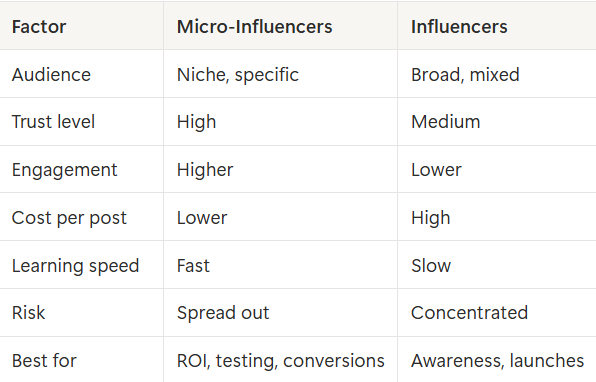
This table explains why micro-influencer ROI often wins even when reach is way smaller. According to recent data, brands typically earn $5.78 for every $1 invested in influencer marketing, and that number skews even higher with micro-influencers due to their better engagement rates and lower costs.
Where Influencer Marketing Usually Leaks Money
Most brands don't lose money because influencer marketing "doesn't work." They lose money because learning happens slower than spending. With large influencers, one post can cost your entire test budget, if it flops you get thin data, and trying again costs just as much. With micro-influencers, the same budget covers multiple creators, you test different hooks, voices, and angles, patterns show up fast, and you learn while you spend, not after.
That learning speed? That's the hidden driver of strong micro-influencer ROI.
What Micro-Influencer ROI Actually Looks Like IRL
Brands working with micro-influencers usually notice higher engagement per follower (not just total engagement), more saves, replies, and actual DMs, better conversion rates per view, and clearer signals about what messaging actually works. Not every post is a winner…and that's the point. Even average results are useful because they tell you what to adjust next. ROI improves because learning compounds over time.
Research backs this up: 69% of consumers trust recommendations from influencers over direct brand messaging, and that trust runs even deeper with smaller creators who feel more authentic.
Reach vs Results (The Tradeoff Nobody Wants to Admit)
Influencers make sense when you want mass visibility, launch momentum, fast awareness, and social proof at scale. Micro-influencers shine when you want conversions that actually show up in your dashboard, message testing that's affordable, performance insights you can act on, and repeatable, scalable outcomes.
Neither is "better." They just solve completely different problems. The micro-influencers vs influencers debate isn't about winners and losers.It's about timing.
Why This Choice Actually Matters (Like, A Lot)
Choosing wrong can mean burning your budget before learning anything useful, internal pressure to "try something else" before you even got real data, reports that look amazing but sell literally nothing, and repeating the same expensive mistake at higher spend. Choosing right means faster clarity on what works, lower risk, better ROI over time, confidence when it's time to scale, and proof that influencer marketing actually works for your brand.
That's why micro-influencers vs influencers isn't just a tactic debate. It's a strategy one.
When Micro-Influencers Aren't the Move
They're powerful, not magical. Let's be real. Micro-influencers struggle when the goal is pure mass awareness (like, Super Bowl level), celebrity association is literally the point, prestige matters more than performance, or you don't have bandwidth to manage multiple creators. They also won't fix a weak product or unclear positioning. Nothing does.
When Influencers Actually Earn Their Price Tag
Influencers make sense when your message is already proven to work, awareness is the main goal, you want scale, not testing insights, and some inefficiency is acceptable in your budget. Think of influencers as amplifiers. Not testing labs.
How Brands Actually Use Micro-Influencers Today
What works in practice is starting with micro-influencers, testing creators, hooks, and formats quickly, identifying what converts (not just what gets likes), reusing winning content across all your channels, and scaling with confidence once you know what works.
Once this system is running smoothly, coordination becomes the bottleneck. That's usually when teams bring in tools like Bulba.app , not to change their strategy, but to keep creator outreach, content approvals, and performance tracking from becoming absolute chaos. The tool supports the system. It doesn't replace it.
Micro-Influencers vs Influencers: The Short Answer
Choose micro-influencers when you care about ROI (actual revenue, not vanity metrics), learning speed, risk control, and consistency you can replicate. Choose influencers when you care about reach (just putting eyes on something), visibility at scale, brand perception, and top-of-funnel awareness.
Most smart brands use both. Just not at the same time. Test with micro-influencers first. Once you know what converts, then amplify with bigger creators if it makes sense.
The Bottom Line
The micro-influencers vs influencers debate isn't about who wins. It's about when each one makes sense. Micro-influencer ROI wins when clarity matters and budgets are tight (which is... most of the time). Influencers make sense once you already know what works and just need more volume.
With the influencer marketing industry projected to hit $32.55 billion by 2025, brands are increasingly recognizing that smaller creators deliver disproportionate value. In fact, micro-influencers generate approximately 60% more engagement relative to their audience size compared to larger influencers.
Learn first. Scale second. That's how influencer marketing stops being a gamble and starts acting like a system that actually works.
FAQs
Are micro-influencers actually better than influencers?
Often yes for ROI. Micro-influencers build more trust, have tighter communities, higher engagement per follower, and lower costs, which makes them better for clicks, sign-ups, and sales, while bigger influencers are better for reach and hype.
Why is micro-influencer ROI higher?
People still listen to them. They feel like real humans, not ads, so recommendations convert better, and lower costs let brands test more creators faster without risking the whole budget.
How many followers does a micro-influencer have and what engagement is good?
Typically 5,000 to 100,000 followers, but engagement and audience fit matter more. Strong benchmarks are Instagram 2 to 4 percent, TikTok 5 to 10 percent, and YouTube 3 to 5 percent, with real comments, saves, and DMs signaling true ROI.





.png)